
How Long Is the UK Driving Test? What to Expect, How to Book & Tips to Pass
The standard UK car driving test lasts for around 35 minutes of driving. If you are taking an extended driving test because you have been banned from driving, the driving part lasts for around 65 minutes. This is based on the official DVSA guidance for car practical driving tests in Great Britain.
When people ask, “how long is the UK driving test?”, it is worth remembering that the full appointment may feel slightly longer because you will also need to arrive, meet the examiner, complete the eyesight check, answer a vehicle safety question and receive your result at the end.
The practical test is the same length whether you are taking it in a manual or automatic car. The DVSA confirms that the test structure is the same for both manual and automatic cars.
UK driving test length at a glance
| Part of the test | What happens | Approximate time |
|---|---|---|
| Arrival and checks | You arrive at the test centre and meet the examiner | A few minutes |
| Eyesight check | You read a number plate from the required distance | A few minutes |
| “Tell me” question | One vehicle safety question before driving | A few minutes |
| Driving section | General driving, independent driving and road situations | Around 35 minutes |
| Manoeuvre | One reversing exercise during the drive | Included in the drive |
| “Show me” question | One safety question while driving | Included in the drive |
| Result | Examiner tells you whether you have passed or failed | A few minutes |
What happens during the UK driving test?
The DVSA says there are four main parts to the car driving test:
- An eyesight check
- “Show me, tell me” vehicle safety questions
- General driving ability, including independent driving
- Reversing your vehicle
You will drive in a range of normal road and traffic conditions, but not on motorways. During the independent driving section, you may be asked to follow a sat nav, follow traffic signs, or use a combination of both. The examiner will set up the sat nav if one is used, and you cannot use your own sat nav during the test.
The examiner is not looking for perfection. They are checking whether you can drive safely, legally and independently without putting yourself or others at risk.
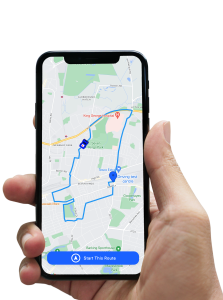
Practise smarter with RouteBuddy and give yourself the confidence to arrive at your driving test ready.
How to book your UK driving test
You should book your practical driving test through the official GOV.UK/DVSA booking service. For car tests in Great Britain, you must book the driving test yourself. GOV.UK states that your driving instructor is not allowed to book, change, swap or cancel a car driving test for you, and it is against the law to book a car driving test for someone else.
Before booking, you must have passed your theory test. GOV.UK also lists the car driving test cost as £62 to £75, depending on the test time and day.
To book online, you will usually need:
- Your UK driving licence number
- A credit or debit card
- Your driving instructor’s personal reference number, if you want to check their availability
The DVSA booking service is available from 6am to 11:40pm, and you can book a test up to 24 weeks in the future. GOV.UK also states that there is no waiting list or cancellation list, although you can change your appointment later and check for earlier appointments.
Important note: DVSA practical tests apply to England, Scotland and Wales. Northern Ireland uses a different driving test booking service through DVA/NI Direct. GOV.UK confirms there is a separate service for Northern Ireland.
What to take to your driving test
You must take the correct documents and a suitable car. GOV.UK says you must bring:
- Your UK driving licence
- Your theory test pass certificate, if you have it
- A car that meets the rules, usually your driving instructor’s car or your own suitable vehicle
Your test can be cancelled and you may not get your money back if you do not bring the right items.
If you use your own car, it must meet DVSA rules. For example, it must be roadworthy, taxed, insured for a driving test, have a valid MOT if required, display L plates or D plates in Wales, have an extra interior rear-view mirror for the examiner, and meet other safety requirements.
How is the driving test marked?
There are three types of driving test faults:
- Dangerous fault: actual danger to you, the examiner, the public or property
- Serious fault: something potentially dangerous
- Driving fault: not potentially dangerous, but repeated driving faults can become serious
To pass your driving test, you must have no serious or dangerous faults and 15 or fewer driving faults.
At the end of the test, the examiner will tell you whether you passed or failed and explain any serious or dangerous faults. You will also get your result by email.
If you pass, the examiner will give you a pass certificate and ask whether you want your full licence sent to you automatically. You can start driving straight away once you have passed, as long as you are properly insured to drive without supervision.
If you do not pass, you will need to book another test and pay again. GOV.UK says the new test date must be at least 10 working days away.
Common reasons learners fail the UK driving test
The DVSA publishes official guidance on the top reasons learners fail the driving test in Great Britain. Common issues include:
- Not making effective observations at junctions
- Not using mirrors correctly when changing direction
- Not moving off safely
- Incorrect positioning when turning right at junctions
- Not responding correctly to traffic lights
- Poor control of steering
- Not responding correctly to road markings
- Not responding correctly to traffic signs
These are exactly the types of areas to practise before test day. Passing is not about memorising one route. It is about showing the examiner that you can deal with real roads safely and confidently.
Tips to pass your UK driving test
1. Practise around your chosen test centre
Every test is different, but practising near your chosen test centre can help you understand the types of roads, junctions, roundabouts, speed limits and traffic conditions you may experience.
This is where RouteBuddy can help. RouteBuddy gives learners access to test centre route practice, turn-by-turn navigation and local route familiarity, helping you build confidence before the real test. Use it alongside professional driving lessons and private practice so you feel more prepared on unfamiliar roads.
2. Do not rush into booking too early
A driving test slot is not the same as being test-ready. Before booking, you should be able to drive independently, deal with mistakes calmly, follow road signs, manage roundabouts and junctions safely, and control the car confidently.
Ask your instructor for honest feedback before booking. A good question is: “Would I be safe driving on my own today?”
3. Focus on observations at junctions
DVSA guidance lists ineffective observations at junctions as one of the top reasons for failing.
Before emerging, turning or crossing traffic, make sure you look properly, assess speed and distance, and only move when it is safe. A quick glance is not enough if the situation needs a proper check.
4. Use mirrors before changing speed or direction
Mirror use is not just about ticking a box. You need to check the correct mirrors at the correct time, then act safely on what you see.
Remember: mirrors before signalling, mirrors before changing direction, mirrors before changing speed, and mirrors before moving position.
5. Keep your positioning clear
Poor lane discipline, late lane changes and incorrect positioning at junctions can quickly lead to serious faults. Practise approaching junctions early, reading road markings, choosing the correct lane and staying in position unless it is safe and necessary to move.
6. Practise independent driving
During the test, you may need to follow a sat nav, traffic signs or both. The examiner will set up the sat nav if one is used.
Practise listening to directions, planning early and staying calm if you miss a turn. You are not usually marked down just for going the wrong way, as long as you continue safely and legally.
7. Know the “show me, tell me” questions
You will be asked two vehicle safety questions. The “tell me” question is asked before you start driving, and the “show me” question is asked while you are driving.
A wrong answer alone is unlikely to ruin your test, but it can add a driving fault. Practise these in advance so you are not worrying about them on the day.
8. Take a mock test
A mock test with your instructor can help you understand how test pressure feels. Try to treat it like the real thing: no extra help, no constant reminders and no stopping to discuss mistakes.
This will show whether you can drive independently under pressure, which is one of the biggest differences between lessons and the actual test.
9. Use RouteBuddy for extra confidence
RouteBuddy is useful for learners who want to feel more familiar with local test centre roads. You can practise routes, revisit tricky areas and build confidence with real driving situations.
It is not a replacement for lessons with an approved driving instructor, but it can be a powerful extra tool for learners who want to practise smarter between lessons.
Download RouteBuddy and start practising your local test routes before test day.


What to expect on driving test day
Arrive early, but not too early. Make sure you have your licence, your car is ready and you know where to meet the examiner.
The examiner will check your licence, ask you to sign a declaration and then carry out the eyesight check. You will then answer a “tell me” vehicle safety question before starting the drive.
During the test, the examiner will give directions clearly. They are not trying to trick you. They simply want to see whether you can drive safely in real traffic.
You may be asked to complete one reversing manoeuvre. You may also be asked to pull up on the left and move off again, including moving off from behind a parked vehicle or on a hill.
At the end, the examiner will tell you the result. Whether you pass or fail, listen carefully to the feedback because it will help you understand what went well and what needs work.
Can you change your driving test appointment?
Yes. GOV.UK says you can change a car driving test appointment up to 2 times. You can find an earlier test, move your test to a later date or change the test centre. You usually need to give at least 10 full working days’ notice for car driving tests, otherwise you may have to pay again.
Are UK driving test pass rates different by test centre?
Yes, pass rates can vary by test centre, area and learner experience. The DVSA publishes official car theory test and driving test data, including pass rates, waiting times and availability for Great Britain overall and by test centre. The latest DVSA data page was updated on 25 June 2026 with car driving test data to March 2026.
However, you should not choose a test centre only because it has a higher pass rate. You are more likely to feel confident at a centre where you have practised the local roads, junctions and traffic conditions.
FAQs about how long the UK driving test is
How long is the UK driving test?
The standard UK car practical driving test involves around 35 minutes of driving. Extended driving tests last around 65 minutes.
Is the driving test exactly 40 minutes?
The official DVSA guidance says you will drive for around 35 minutes. The full appointment may feel closer to 40 minutes once checks, questions and feedback are included.
How long is the independent driving part?
The independent driving part usually lasts between 20 and 35 minutes. You may follow sat nav directions, traffic signs or a combination of both.
Do you drive on motorways during the UK driving test?
No. DVSA’s Ready to Pass guidance says you will drive in various road and traffic conditions, but not on motorways.
How many minors can you get on a driving test?
You can pass with 15 or fewer driving faults, often called minors, as long as you do not make any serious or dangerous faults.
What is an instant fail on a driving test?
A serious or dangerous fault will result in a fail. Dangerous faults involve actual danger, while serious faults are potentially dangerous.
Can my driving instructor book my test for me?
No. GOV.UK says you must book, change, swap or cancel your own car driving test. Your instructor is not allowed to do this for you.
What do I need to book my driving test?
You usually need your UK driving licence number, a credit or debit card and your instructor’s personal reference number if you want to check their availability.
What do I need to bring to my driving test?
You must bring your UK driving licence, your theory test pass certificate if you have it, and a suitable car. Your test may be cancelled without a refund if you do not bring the right things.
Can I use my own car for the driving test?
Yes, but only if it meets DVSA rules. It must be roadworthy, insured for a driving test, taxed, fitted with L plates or D plates in Wales, and have an extra interior rear-view mirror for the examiner, among other requirements.
Can I use my own sat nav during the driving test?
No. If a sat nav is used, the examiner will set it up for you. You cannot use your own sat nav during the test.
How soon can I retake my driving test if I fail?
If you do not pass, you need to book another test and pay again. The new date must be at least 10 working days away.
Final thoughts
So, how long is the UK driving test? The simple answer is: around 35 minutes of driving for a standard car test.
The better question is: are you ready to drive safely and independently for those 35 minutes?
Before test day, focus on the most common fail areas, practise around your chosen test centre, take mock tests and build confidence with local roads. RouteBuddy can help you practise test centre routes, understand local road layouts and feel more prepared before the real thing.